In the LocalGovDigital sector, within our respective councils we spend an awful lot of money engaging consultants to help us do things.
Sometimes, the expenditure on the consultancy is genuinely justified - there's a skills gap within the organisation that training won't adequately fill immediately, because skills require experience as well as knowledge, and the consultants can provide both for the period of engagement; if the consultants are good, and the contract is robust, the terms of engagement for the consultancy will include proper knowledge transfer to enable the organisation to not need to engage the consultancy again.
Sometimes, the consultants are engaged not because of a skills gap, but because of a capacity gap - the skills exist within the organisation, but there are four people employed to do the job and there's a temporary need to do eight people's worth of work in a short space of time. As it happens, that's how I entered the sector in the first place, though it would be an exaggeration to say I was employed as a consultant!
Sometimes, though, there isn't actually a skills or capacity gap at all; there's the unflattering characterisation of consultants that what they do is interview all the staff [...]
But if you have a few moments spare in your busy day, the answer in most cases is the same, however there's a more nuanced argument to the question than just a single word.
It's a question I've seen many times in LocalGovDigital circles, and since it came up again in the Slack group recently I thought it might be helpful to put my answer to the person asking the question there in the form of a post for a wider audience.
So the first and foremost question for any council considering building an app might be what is the established clear user need for an app that a good mobile-first website can't provide?
And by 'established clear user need', I don't mean "as a civically-engaged citizen, I need to tell the council about a pothole or some flytipping I've just seen whilst out and about, so that I can drive safely along that road next week". The question is, is there a clear user need for an app which a user will download to their phone (and remember on which screen or folder the icon for the app is kept) which you can [...]
A friend this morning directed me to a link to a certain council website, which she was fairly sure had been completely redesigned recently (at the time of writing the Internet Archive WayBack Machine seems to be down, so I can't check). She'd sent it to me because she was aghast at something she saw on it, but what I saw below what she was aghast about was even more terrible to behold...
A service menu on the website home page thus:
Council website service menu
Services
Jobs
Council Tax
Recycling and waste
Benefits
Transport and roads
Housing
Adult Social Care
Children, young people and families
Sport and activities
Planning and building control
Education and skills
Business
Your Council
Libraries
Births, deaths and marriages
Consultations
What is this random order this list of links has been presented in?
If you know me well, you know the extent to which this sort of thing rattles my cage. In order to get myself even more rattled, I went to three other council website with a similar home page service menu User Experience strategy:
Way back in 2016 I made the content strategy I'd written for the previous version of our website publicly available and edited it to make it generic rather than specific.
Time passes and I've decided to update some parts of that document and completely rewrite other parts from scratch; the finished version is still a while off as of right now, but I thought in the meantime I'd share a sneak preview of the updated Personas section.
In common with standard practice in the communications, marketing, and brand management industries, content is best designed having in mind a number of fictional individuals and families which are intended to represent the breadth of potential users of the website. The purpose of these profiles is to enable web editors and content authors to have in their minds a picture of actual people with real and definable needs who will be users of the web content to focus on, rather than thinking in terms of a generic amorphous mass of ‘just anybody’. The profiles also are there to remind us of the wide diversity of citizens we provide services to and who wish to transact with us, [...]
Please write me 10 paragraphs which could be the core tenets of a new religion centred around the veneration of the Sinclair ZX81 personal computer:
The Sinclair ZX81 personal computer was a groundbreaking device that revolutionized the world of computing. For those who are passionate about this computer, it can become a focal point of a new religion. Here are ten core tenets that could form the basis of a religion centered around the veneration of the Sinclair ZX81 personal computer.
1. The Sinclair ZX81 is a holy device, and its significance cannot be overstated. It has paved the way for modern computing and continues to be a symbol of innovation, creativity, and human ingenuity.
2. We believe that the Sinclair ZX81 was divinely inspired, and that its creator, Sir Clive Sinclair, was a prophet who brought the gift of computing to the masses.
3. The Sinclair ZX81 represents a sacred bridge between the physical and digital worlds. It allows us to explore and understand the universe in ways that were previously impossible, and helps us to unlock the secrets of the cosmos.
4. The Sinclair ZX81 is a tool of enlightenment, and we believe that its use can [...]
As an AI language model, I’m seeing that ChatGPT has now gone from the fun toy folks have been playing with to a tool that people are using to write full text prose passing it off as if they wrote it themselves, and I’m noticing an increased amount of people on LinkedIn reposting inspiring thought-leadership and game-changing marketing copy there. There is no doubt that the power of ChatGPT will stay with us for many years to come.
The thing is, if you’ve played with ChatGPT enough and have an analytical eye for content, you can see it a mile off; whence whenever I’ve seen what I’ve suspected as ChatGPT content I’ve checked it in ChatGPT Zero — https://gptzero.me/ — and indeed sure enough, it’s confirmed my suspicion.
I’m a full supporter of using technology to help the creative process; I’ve been using computers in my own creative work since 1985. As previously mentioned, I used ChatGPT myself to help me write a song, and I’ve been having lots of fun using Stable Diffusion, Dall•E, and Midjourney to generate images, some of which I might print on mugs to try to sell.
But I’d like to emphasise a massive note of caution to [...]
I’m not a fan of Ed Sheeran’s music, but I’m absolutely a fan of the way he consistently stands up for the principle that all creative work is fundamentally based on all the creative work which has preceded it — all creative work is essentially a mash-up or uses samples, some of it explicitly, some of it by virtue of flowing through the veins.
‘Sheeran responded that he sometimes mixed together songs with similar chords at his performances, and appeared to grow frustrated when Ms Rice cut him off.
"I feel like you don't want me to answer because you know that what I'm going to say is actually going to make quite a lot of sense," he said. "You could go from Let it Be to 'No Woman, No Cry and switch back," Sheeran continued under oath, referring to the Beatles and Bob Marley classics’
International copyright law when it comes to protecting creativity is fundamentally broken — it’s not written with a view to protecting the rights of creators to earn from their work and protect them from being ripped off by others, it’s written with a view [...]
If you have a liking for Apple products, then indirectly you have a liking for the design principles of Dieter Rams, whose work as Chief Designer at Braun has been credited as a major influence on Jony Ive, the former Chief Design Officer at Apple whose design ethos can be seen coursing through the veins of every Apple product since 1997. Dieter Rams himself coined his 10 Principles for Good Design as a handy distillation of his whole ethos.
Good design:
is innovative – The possibilities for progression are not, by any means, exhausted. Technological development is always offering new opportunities for original designs. But imaginative design always develops in tandem with improving technology, and can never be an end in itself.
makes a product useful – A product is bought to be used. It has to satisfy not only functional, but also psychological and aesthetic criteria. Good design emphasizes the usefulness of a product whilst disregarding anything that could detract from it.
is aesthetic – The aesthetic quality of a product is integral to its usefulness because products are used every day and have an effect on people and their well-being. Only well-executed objects can be beautiful.
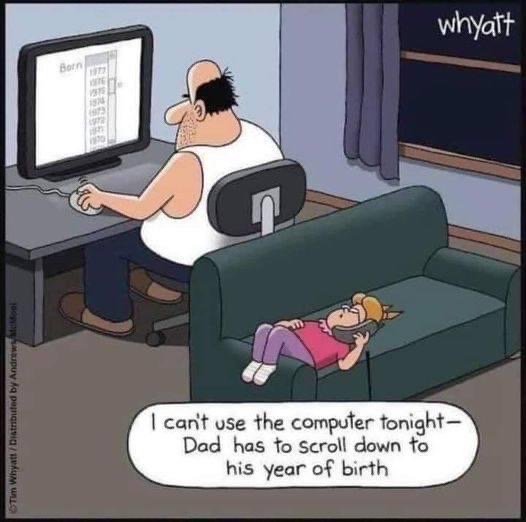
A friend earlier today shared this amusing image on Facebook:
This is a common problem with date calendar pickers on apps and websites - we want to make it easy for users to enter dates by a calendar, but if the date needing to be entered is more than a couple of years in the past it's a complete nightmare to scroll back.
If only there was a solution which could make this easier for users?
How many times have you been to read the Accessibility Statement of a website, and if it’s even mentioned maps, it’s said ‘unfortunately it’s not possible to make maps accessible’?
I was recently asked by a colleague to comment on the accessibility issues of a request by an internal department to put some interactive maps online. It transpired along the way there had been some confusion between the terms ‘access’ and ‘accessibility’, because when I went to look at the content in question in order to form an opinion I couldn’t actually access it anyway, because it was on an external party’s Sharepoint site protected by a login, and it turned out it was that aspect they wanted some help with.
So at the point of my initial reply to the email, without having seen the content, all I was able to respond was - to my shame - ‘because there’s an understanding there’s no real solution to making maps accessible, maps are generally allowed to be exempt from accessibility requirements’. I hopefully redeemed myself with my next sentence by adding ‘however, in many cases something at face value looks like it’s not possible to make it accessible, but with a degree [...]
If you enjoy this, you might like some more of my music on YouTube Music, on Spotify, on Apple Music, and on Amazon. If you like it enough to give me some money, you can do that on Bandcamp.
The code behind this site is a bit of an abandoned project; I originally had lofty ambitions of it being the start of a competitor for Twitter and Facebook, allowing other people to also use it turning it into a bit of a social network. Needless to say I got so far with it and thought who did I think I was! Bits of it don't work as well as I'd like it to work - at some point I'm going to return to it and do a complete rebuild according to modern standards.
 Perfect